Design Guides
Interior Design Cost in Dubai: How Budgets Are Built and What Drives Them
Ask ten companies what interior design in Dubai costs and you will get ten different answers — often for the same apartment or villa. That is not necessarily dishonesty. It is because “interior design cost” is not one thing. One quote may cover drawings only, another drawings plus the full build, and a third everything down to the last cushion — and a single per-square-foot rate hides all of those differences. This guide does something more useful than another rate table: it shows how a professional interior design budget in Dubai is actually built, layer by layer, what drives the total up or down, and how to compare quotes on a fair basis before you sign anything.
First, separate the three things people call “interior design cost”
Most confusion — and most disappointing projects — start here. A budget can include any combination of three different scopes:
- Design only. Concepts, space planning, drawings, 3D visualisation where required, and material and finish selection. You receive a design package and then tender the build separately. The design fee is only a small part of the project’s eventual total, even though it decides almost everything else.
- Design and fit-out. The design plus the physical build: partitions, ceilings, flooring, joinery, lighting, MEP coordination and finishes, executed and supervised to handover. This is the largest part of most budgets, and it is where fit-out scope must be spelled out precisely.
- The furnishing layer. Furniture, curtains, rugs, decorative lighting, art and accessories. This layer is sometimes included in a turnkey price and sometimes left entirely to the owner — a difference that alone can make two quotes for the “same” project look incomparable.
Before you compare any two numbers, ask each company which of the three scopes their price covers. A lower quote that excludes the build, or excludes all furniture, is not cheaper — it is smaller.
How a budget is built, layer by layer
1. Design and technical development
Good design is paid thinking time: measuring and understanding the space, concept development, layouts, detailed drawings and a finishes schedule that builders can actually price and build from. Skimping here does not save money — it moves the cost into mistakes, rework and arguments on site. A complete design package is also what makes accurate pricing possible in the first place.
2. Approvals, NOCs and building rules
In Dubai, work beyond paint and furniture usually needs consent before it starts. Depending on the property and the scope, that can involve your building management or master community (which issues the NOC and sets working hours, access rules and any deposit), and — where partitions, ceilings, electrical load, plumbing, air conditioning or fire safety are touched — the relevant authority for that property. Requirements vary by building and community, so the route for your property should be confirmed before the design is finalised. Approvals carry fees, time and constraints, and a quote that ignores them is incomplete.
3. Fit-out works: the built fabric
Partitions, ceiling systems, flooring, wall finishes, painting and tiling — the physical transformation of the shell. This layer scales directly with area, room count and how much of the existing fabric changes. A cosmetic refresh of sound surfaces costs a different order of effort from stripping a space back and rebuilding it.
4. MEP coordination
Mechanical, electrical and plumbing work sits behind almost every visible decision: moving a kitchen or bathroom, adding lighting circuits and power points, adjusting air conditioning for a new ceiling or layout. It is largely invisible in the finished room, which is exactly why it is under-budgeted — and why layout changes cost far more than surface changes.
5. Joinery: often the largest visible driver
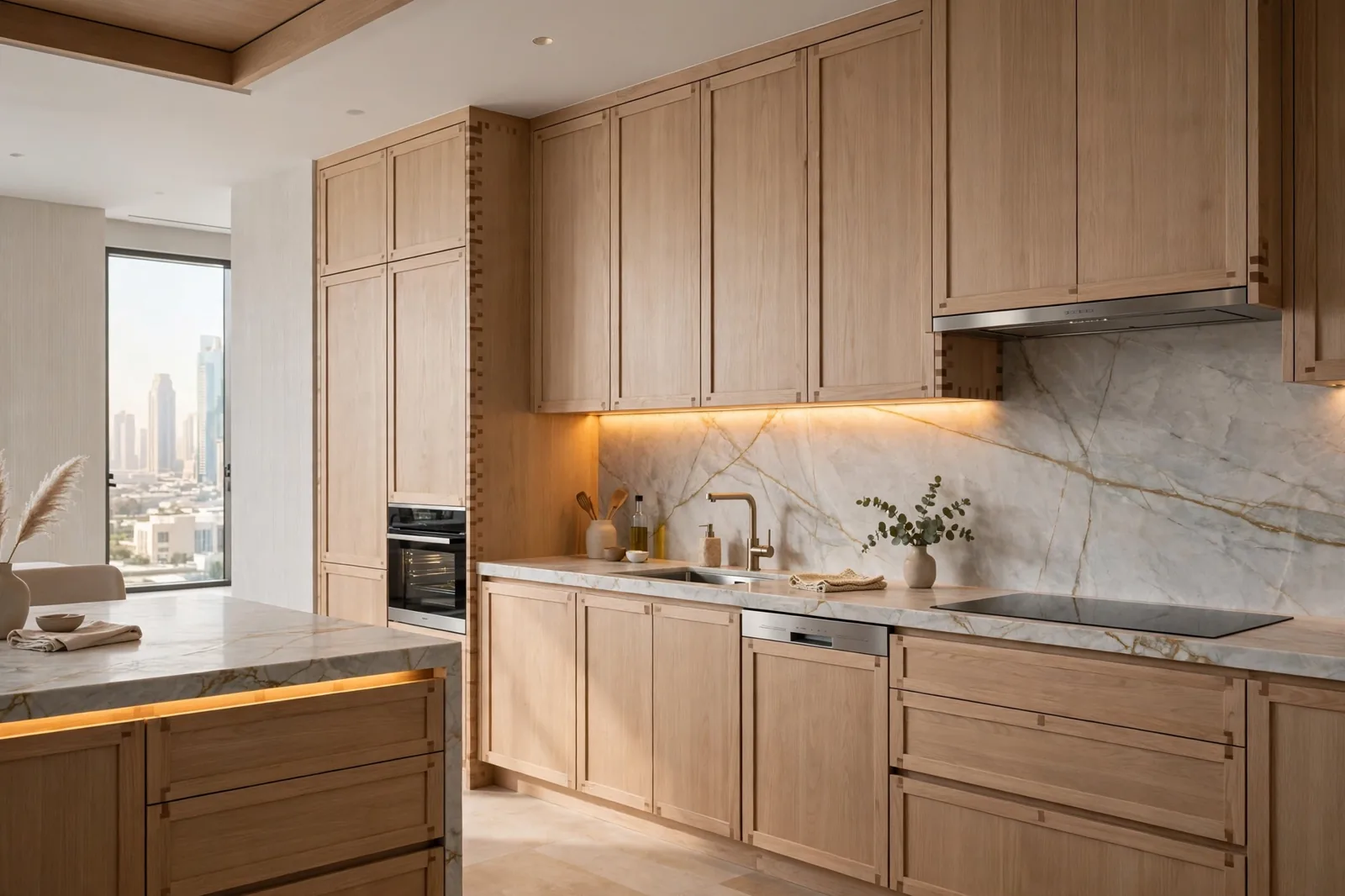
Kitchens, wardrobes, vanities, TV walls, bookshelves and wall panelling are made to measure for your space, and together they frequently form the single biggest visible line in a residential budget. The specification decides the price: carcass and door materials, hardware quality, internal fittings, finish, and how much of the home is bespoke. Our guide to how a turnkey fit-out is structured explains how joinery sits inside a single accountable scope.
6. Materials and finishes
Stone or porcelain, engineered wood or tile, locally stocked or imported and made to order — every surface is a tier decision, and the tiers multiply across a whole home. The right answer is rarely “best everywhere”: it is the right material on each surface, chosen for how that surface is used, as we set out in our comparison of marble and porcelain for kitchens and bathrooms. Long lead times on imported pieces also affect programme and cost, not just taste.
7. Furniture, curtains and the finishing layer
Sofas, beds, dining furniture, window treatments for Dubai’s strong daylight, rugs, decorative lights and accessories. Ready-made pieces, custom-made pieces and imported brands sit at very different levels, and this layer can be phased — completed at handover, or built up over time — in a way the built fabric cannot.
8. Management, snagging and handover — plus contingency
Someone has to sequence trades, check quality, manage deliveries into buildings with strict access windows, snag the finished work and hand over a complete space. Whether that coordination sits with one accountable team — the design and build model — or with you, it is real work with a real cost. Finally, every honest budget holds a contingency for what opening walls and ceilings reveals, and for the changes owners inevitably make. A budget with no contingency is not lean; it is unfinished.
What drives the total up — and down
- Scope and room count. More rooms means more drawings, joinery, finishes and time. Kitchens and bathrooms are the most expensive rooms in any home because they concentrate joinery, stone, plumbing and appliances.
- Layout changes vs cosmetic work. Keeping wet areas, partitions and services where they are is the single biggest saver. Moving them triggers MEP, approvals and making-good everywhere they touch.
- The condition of the existing space. A sound, well-built unit needs preparation; a tired one may need its substrates, wiring or plumbing addressed before any finish can go on.
- Custom vs ready-made. Bespoke joinery and furniture fit perfectly and store more, but made-to-order always costs more than well-chosen ready pieces.
- Material tier and origin. Book-matched natural stone, imported tiles and European hardware escalate a budget faster than almost anything else — decide early which few surfaces genuinely earn it.
- Timeline pressure. Compressed programmes, restricted building working hours and out-of-hours access all add cost or limit what is achievable.
- Late changes. A change on paper costs a redraw; the same change after joinery is ordered or a ceiling is closed costs demolition, reorder and delay. Freezing the design before the build starts is the cheapest decision in any project.
Why a per-square-foot rate misleads
Two villas of identical size can need completely different work: one a cosmetic refresh with its kitchen kept, the other a full renovation with moved plumbing, new joinery throughout and imported stone. Any single rate that claims to cover both is averaging away everything that matters. Rates also conceal what is excluded — approvals, VAT, furniture, appliances, contingency — until those items appear later as “extras”. Use published rates, if at all, only as a rough signal that a company works in your general segment. Your real budget can only come from a defined scope, measured from your actual property.
How to compare quotes fairly
- Is the scope design only, design and build, or turnkey including furniture — and is that stated in writing?
- Are materials and products named specifically, or listed as vague allowances that can be substituted later?
- What exactly is the joinery specification — materials, hardware and internal fittings?
- Are approvals, NOCs and building deposits included, arranged by the company, or left to you?
- Is VAT included in the total, and are payment stages tied to completed progress?
- How are variations handled and priced if you change something mid-project?
- Is there a contingency, who controls it, and what snagging and handover process closes the project?
If a quote cannot answer these, it is not yet a price — it is an estimate waiting to grow. For villas specifically, our earlier guide to where to invest your villa budget covers the priority question — which layers deserve the strongest spend — while this article covers the structure underneath it.
Controlling a budget without ruining the result
Set priorities before prices: decide which rooms and surfaces matter most and protect them. Spend on what is built in and hard to revisit — layout, lighting circuits, flooring, joinery, kitchens and bathrooms — and allow the decorative layer to evolve. Choose materials surface by surface rather than applying one tier to the whole home. Keep the contingency intact for genuine surprises instead of spending it on upgrades in week one. And put design and execution under one accountable process where you can: when the team that drew it also builds it, budget decisions stay connected to build reality, which is the core of professional interior design and fit-out planning. You can see the standard that structure produces in our project portfolio.
A sensible way to start
Write a room-by-room brief first — what each space must do, what stays, what changes. Then have the property visited and measured, agree the scope in writing, and only then ask for a priced proposal built on that scope. That sequence turns “how much does interior design cost in Dubai?” from an unanswerable question into a budget you can actually plan around, compare and control.
If you are planning a villa, apartment or commercial interior in Dubai and would like a budget built properly — scope first, then price — Space & Design Interior Decoration LLC can help. Design With Purpose. Built With Precision. Tell us about your property and your plans via our contact page and our team will discuss the right next step.