Design Guides
Dubai Marina Apartment Interior Design: Designing Around the View
In a Dubai Marina apartment, the view is the most valuable thing in the room — water, yachts, towers and open sky that no furniture budget can buy. The designer’s first job is therefore not to choose a sofa or a colour, but to protect that view: to plan the layout, palette and window treatments so the apartment frames the water and skyline instead of competing with them. Get that right and even a compact one-bedroom feels generous; get it wrong and the best thing about the apartment is hidden behind tall furniture, heavy curtains and clutter.
Start by reading the view you actually have
No two Marina apartments look out on the same thing: one faces the canal, another the open sea, another a skyline of towers — and the view from the living room is often quite different from the view from the bedroom. Before any layout is drawn, stand at each window at different times of day and note what the eye lands on first, where the sun comes in and when, and what is directly opposite. A neighbouring tower a few metres away changes the privacy plan completely; a west-facing window changes the afternoon completely. That survey decides the rest: the best-view room becomes the living space if the plan allows it, the seating faces the glass, and the window treatments are chosen for the sun that room actually gets. It is the same principle behind good interior design everywhere — plan from the architecture outwards — but in the Marina the architecture is the glass, so the glass comes first.
Plan the layout around the glass
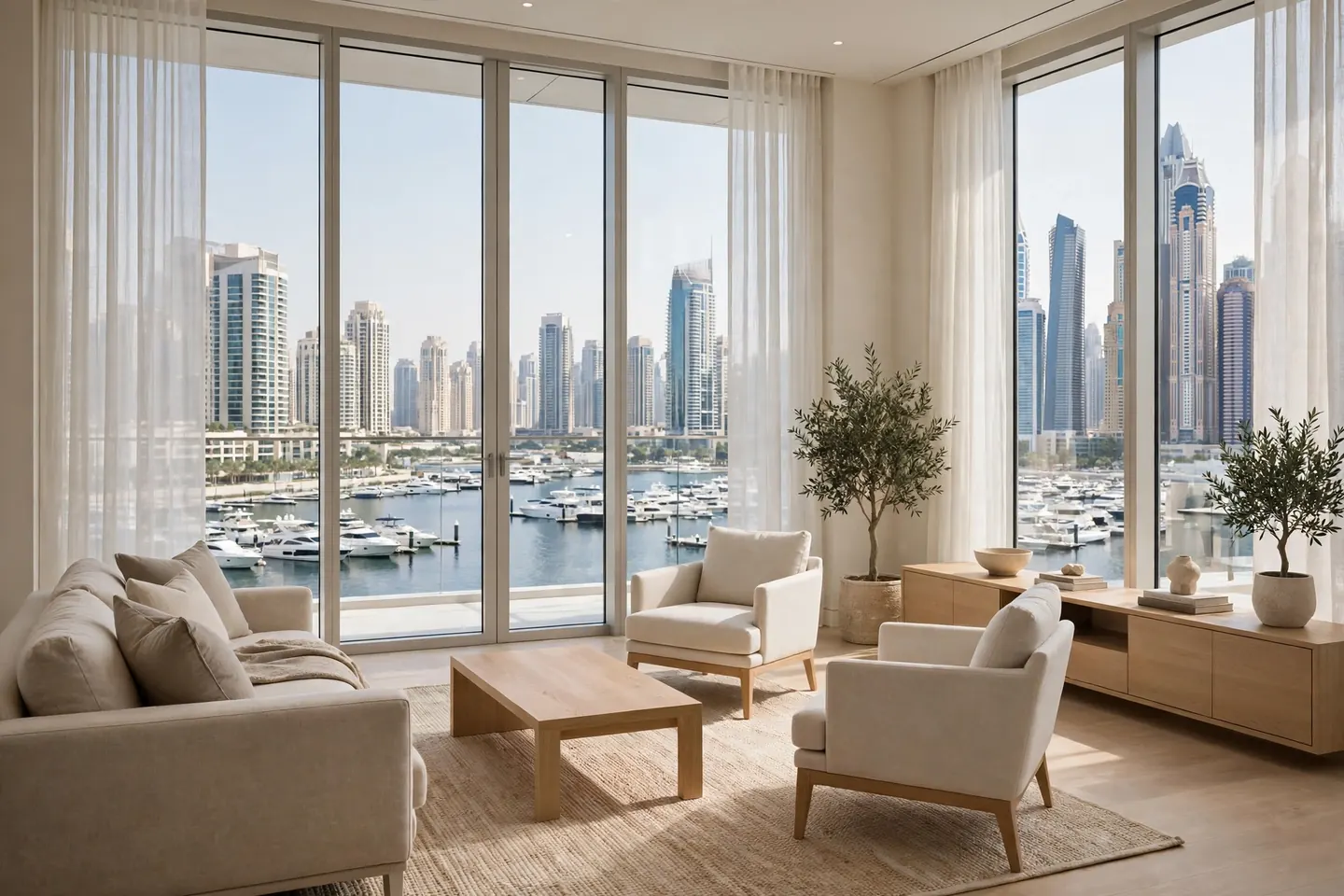
Once the view is understood, arrange the room so nothing stands between the people in it and the water: low-profile furniture near the windows — a sofa, armchairs and a low coffee table, all sitting well below the sill line — and taller pieces (bookcases, tall storage, a media wall) along the internal walls, where they cannot cut across the sightline. The main seating group should face the view, or at least angle towards it, so the room is lived in looking out rather than looking at a wall.
Keep the sightlines clear across the apartment, not just in the living room. Many Marina apartments are open-plan, and the view gains enormously when it can be seen from the dining area and the kitchen as well as from the sofa: no tall divider between living and dining, no shelving unit parked in front of the glass, circulation along the back of the room rather than across the window wall. In a studio or compact one-bedroom, slim-profile multifunctional pieces — an extendable dining table, nesting side tables, a storage bench — keep the floor open, as our guide to smart design for compact Dubai apartments explains. The same thinking applies room by room: a low headboard and a bed facing the water, a dining table near the glass. Our room-by-room apartment planning guide covers the full sequence; here the rule is simply that every room’s best seat should face the glass.
A palette that lets the water and the sky lead
A strong view needs a quiet room. If the interior competes with the marina — bold feature walls, loud patterns, dark heavy furniture — the eye has nowhere to rest, and the apartment feels smaller and busier than it is. The palette that works best is therefore a calm, light one: warm neutrals as the base — off-white, sandy beige, pale taupe — with one natural timber carried through the joinery and furniture, and colour introduced in small, changeable accents rather than in fixed surfaces.
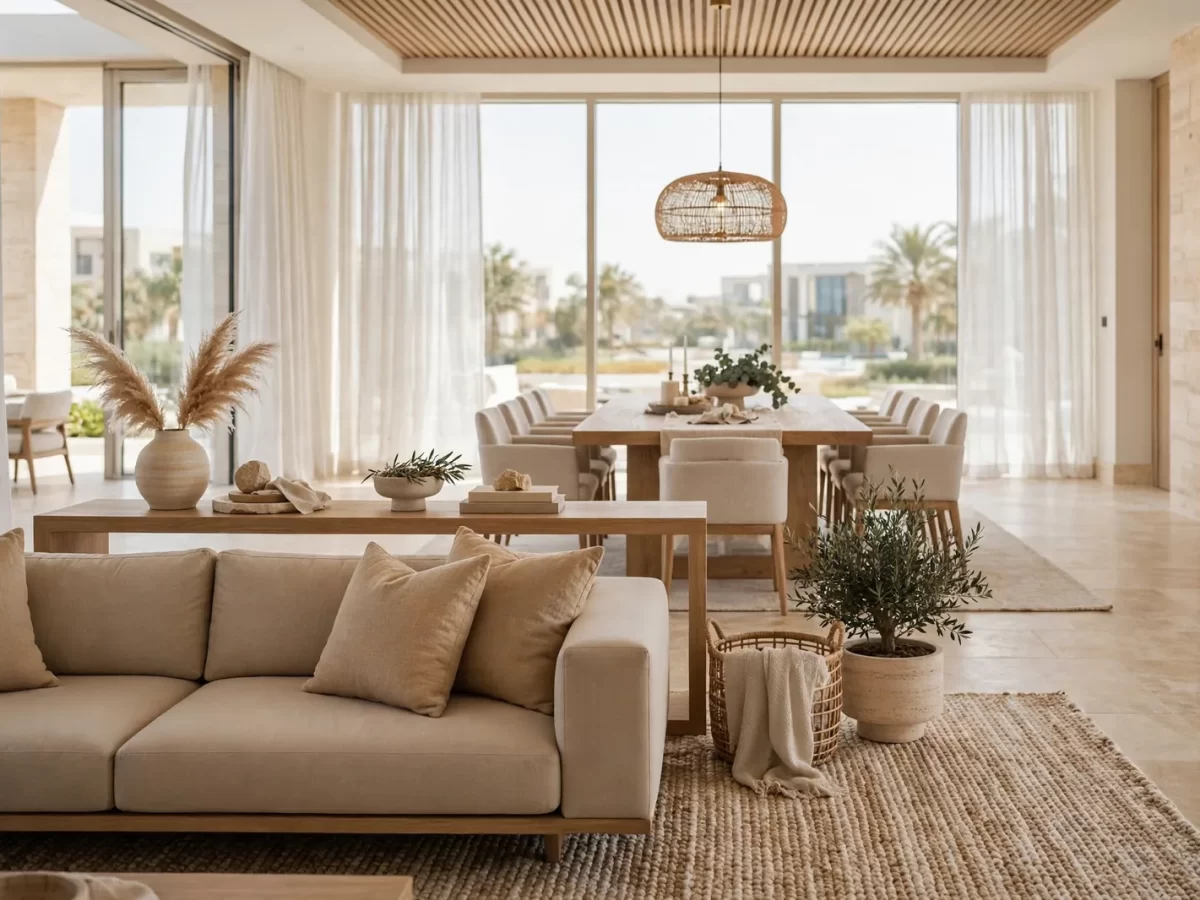
Texture does the work colour would otherwise do: a woven rug, linen or bouclé upholstery, a stone-topped side table, brushed-metal light fittings. Against the blue of the water, those warm, matte surfaces read as calm and premium — and they photograph well, which matters for owners who let the apartment as well as for those who live in it. Bring a touch of the view’s own colours inside — a blue-grey cushion, a muted terracotta throw — but keep it to accents: the marina is the feature wall.
One practical note: bright, ever-changing waterfront light turns glossy surfaces into glare, so choose low-glare, matte finishes for floors and large furniture — and build the base palette first, as our guide to choosing interior colours for a modern villa sets out.
Window treatments: the decision that makes or breaks the room
If one decision determines whether a Marina apartment works, it is the window treatment. Floor-to-ceiling glass brings in the view and the light, but also glare, heat and, at night, a loss of privacy. Heavy curtains across the whole wall solve the privacy and create a worse problem — a dark, closed room whose view has disappeared. The answer is layering.
The working combination for most Marina living rooms is two layers on the same window:
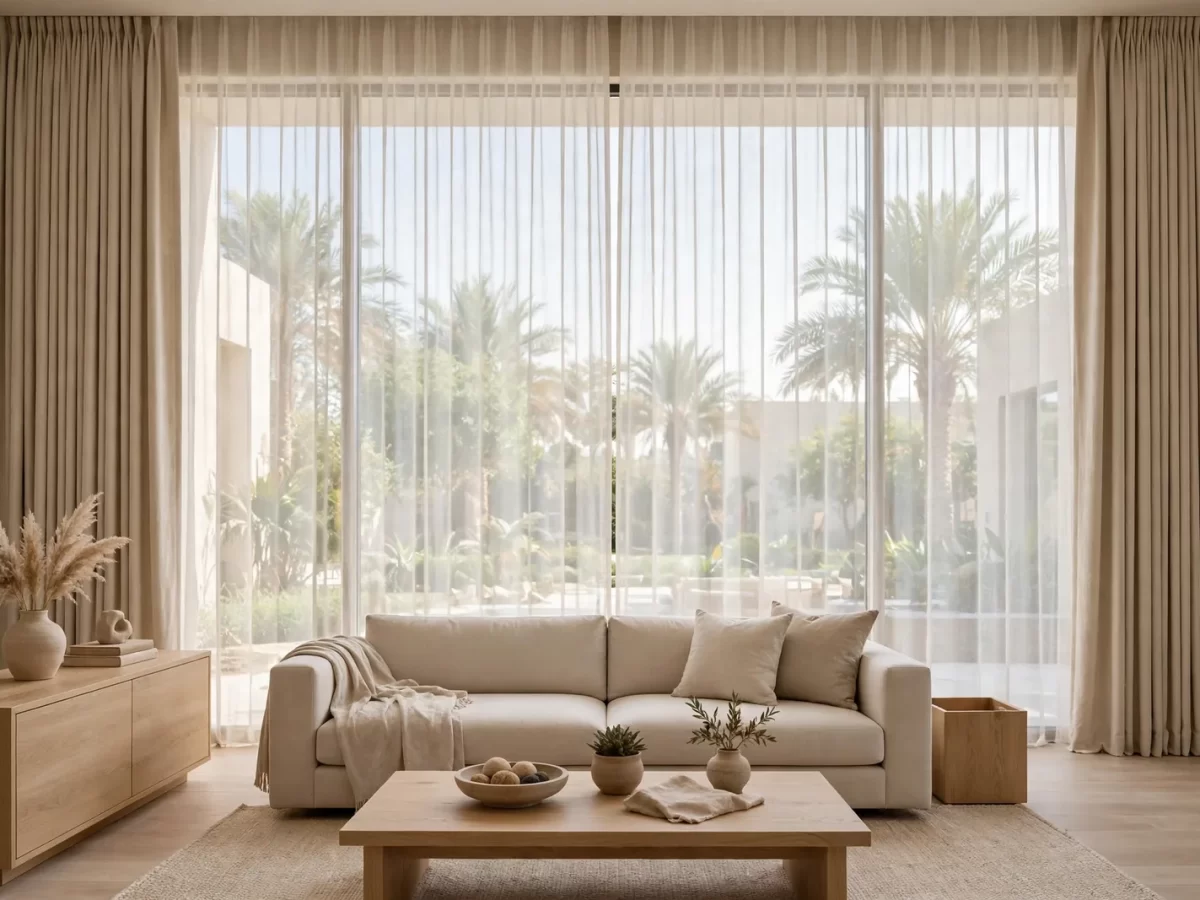
- A sheer layer, worn all day. A sheer — usually voile, or a linen-look weave — softens daylight, cuts glare and gives daytime privacy while the view stays visible. Hung from a ceiling track it runs the full height of the glass, making the room look taller; a wave style gives even, soft folds across a wide window. Allow about twice the window width in fabric, so the sheer folds properly instead of hanging flat.
- A heavier drape, for evenings and bedrooms. Behind the sheer, a blackout-lined drape gives complete privacy and darkness at night, when the lights are on and the sheer alone no longer hides the room. In the living room it is drawn only in the evening, so the glass stays open to the view most of the day.
Where a full curtain would crowd the room — a narrow window wall, a small bedroom — the compact alternative is a blind: a zebra (day-and-night) blind, adjustable between view and privacy, or a roller blind in a solar fabric that filters light and heat while keeping the outlook. Both sit close to the glass and leave the floor free. Whichever route is chosen, treatments should stack clear of the glass when open, not hang across a third of the view — that one detail is the difference between framing the marina and hiding it. Orientation drives the choice: afternoon sun needs the sheer plus the heavier layer, a window facing another tower needs the sheer for daytime privacy, and a bedroom needs blackout regardless, because Dubai’s nights are bright. As our article on designing for Dubai’s climate explains, sun and heat should be designed for at the start, not discovered after the furniture is in.
Light after dark: the apartment’s second view
A Marina apartment has two views — the daytime one, and the evening one, when the towers light up and the water reflects them. Interior lighting should be designed for the second as carefully as window treatments are for the first. A single bright ceiling light turns the glass into a mirror at night and hides the view behind the room’s own reflection. The fix is layered, dimmable light at low level: warm ambient light from indirect sources, table and floor lamps at seated eye level, and accent light on a wall or artwork — all on dimmers, so the room can be bright for cooking and soft for an evening looking out.
Keep the colour temperature warm in living areas — it flatters the room and sits comfortably against the lights of the towers outside — and save cooler, brighter light for task areas such as the kitchen worktop and bathroom mirror, as our guide to warm versus cool lighting sets out room by room. And plan the dining pendant early: it should light the table without throwing light onto the glass behind it, or the view disappears into glare.
Furniture and materials for a high-rise waterfront home
A Marina apartment is a high-rise home on the water, and its furniture should be chosen for that reality. Oversized sofas and deep armchairs that suit a villa will crowd a one- or two-bedroom apartment and block the very view it was bought for. Measure the room — and the lift and the doorway — before ordering anything.
Materials deserve the same practical thought. Waterfront air carries more humidity than inland Dubai, so cold surfaces near glazing or air-conditioning outlets can attract condensation — check the glazing, seals and bathroom and kitchen ventilation before finalising finishes, and favour materials that cope with humidity. For owners who let the apartment, durability matters just as much: tightly woven, easy-to-clean upholstery and hard-wearing kitchen and bathroom surfaces will outlast delicate fabrics by years.
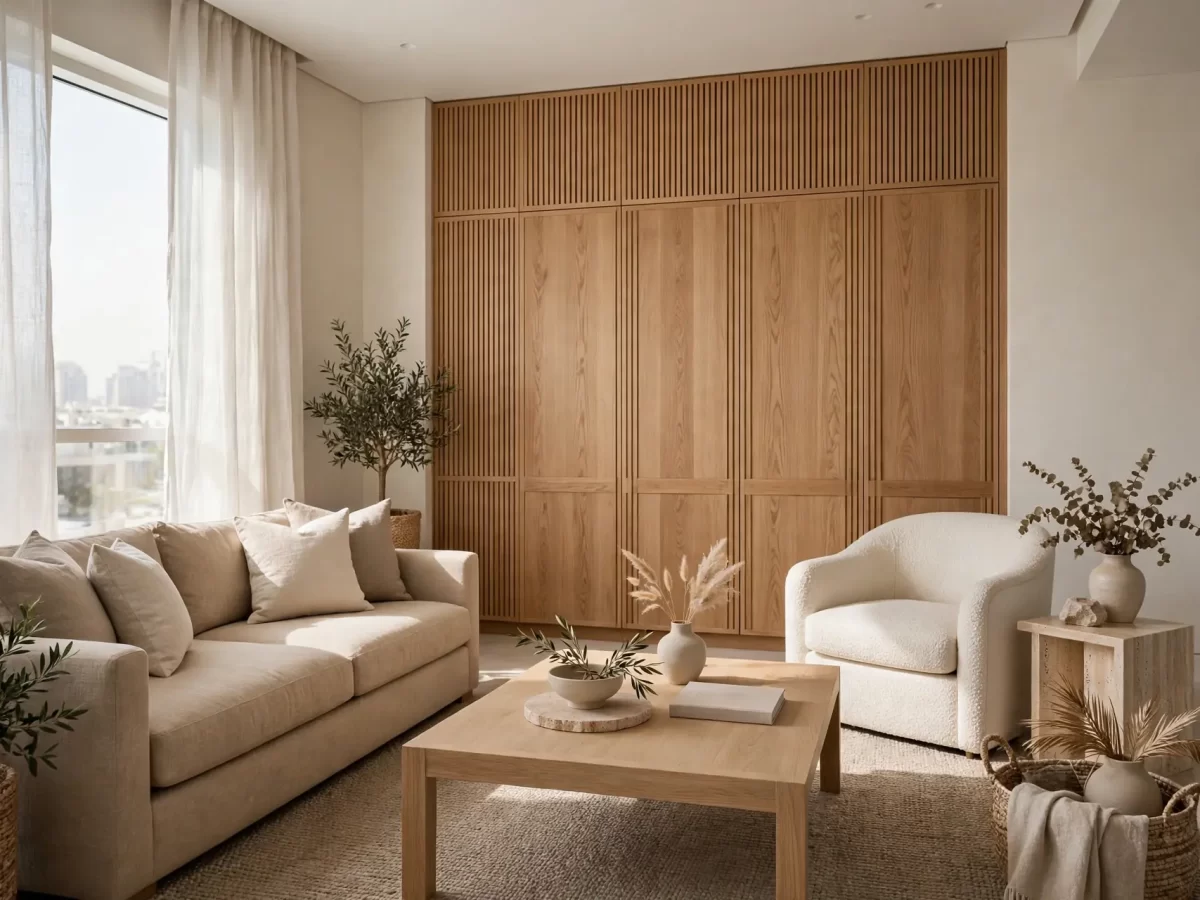
Storage is what keeps the apartment feeling open. Fold it into full-height joinery along the internal walls — wardrobes, a media unit, a hallway cupboard — and keep surfaces clear. It is a quiet move, but it is the one that lets a compact apartment feel calm and generous. Where the work goes beyond furniture into joinery or a fit-out, it belongs in a planned fit-out, agreed with the building before it starts.
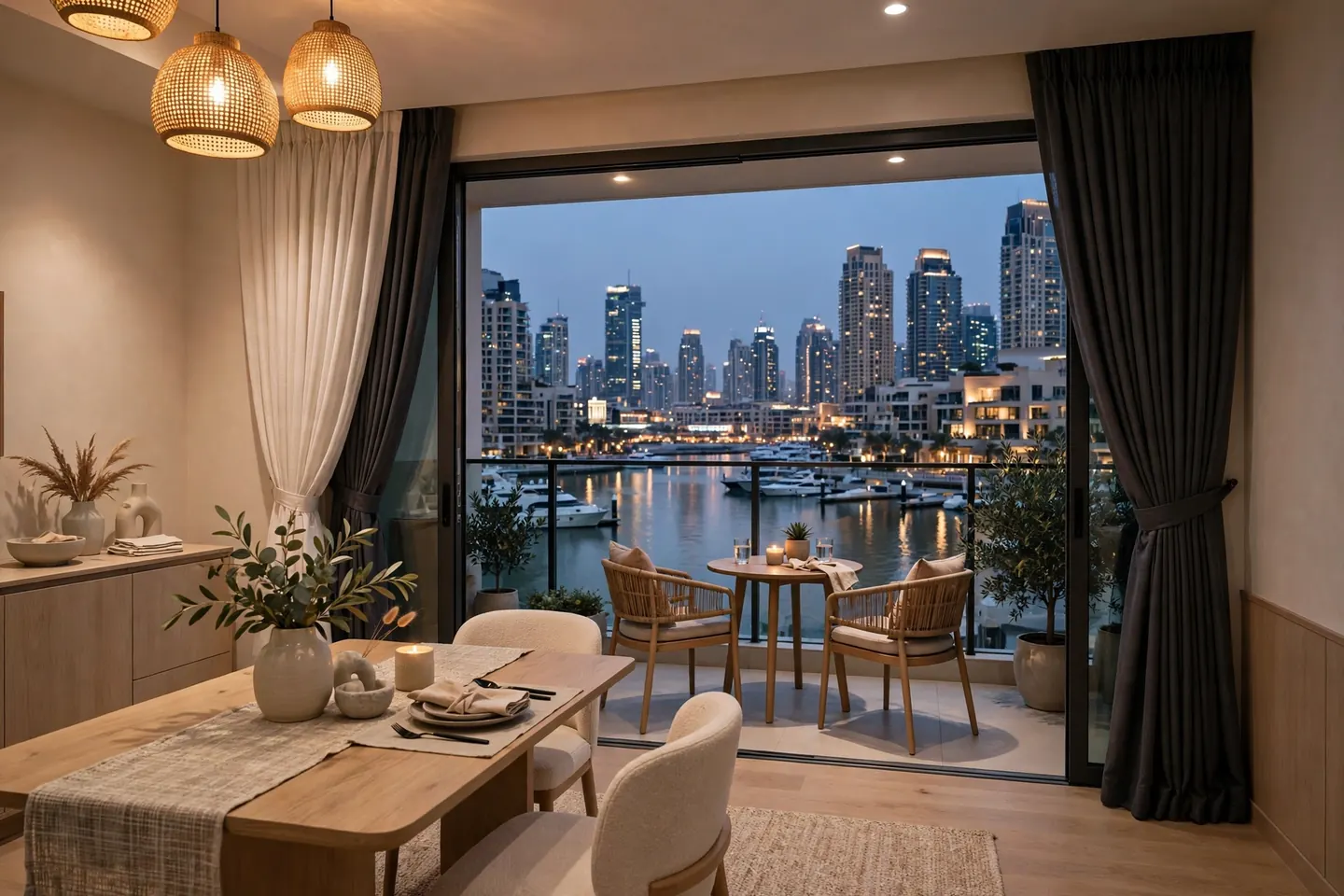
The balcony as a second room
Most Marina apartments come with a balcony, and in many buildings it is genuinely usable rather than ornamental. Treat it as a second room: two chairs and a small table, a little shade, and planting that can cope with wind and sun at height — with furniture kept light and low, so it does not block the view from inside, and securable when the wind picks up. A furnished balcony extends the apartment by a room for much of the year; an empty one is its most wasted space. Before fixing anything to the balcony or the glass, check with building management what can be changed and what any work requires — lift bookings, delivery hours, a no-objection certificate.
A Marina apartment rewards a simple discipline: design around the view, and let everything else — layout, palette, curtains, light, furniture — serve it. The result feels larger than its floor area, comfortable at midday and beautiful after dark. You can see how complete interiors are put together in our project portfolio and our residential projects.
If you own a Dubai Marina apartment — to live in, to let, or to refresh — and would like the layout, window treatments, lighting and joinery designed as one coherent scheme around your view, Space & Design Interior Decoration LLC can help. Design With Purpose. Built With Precision. Tell us about your apartment via our contact page and our team will discuss the right next step.